

Introduction
In this blog post we will zoom in on “Invert always invert”. This is the second mental model of the series, which was used by Charlie Munger for problem solving.
In the Charlie Munger – Mental Models series of QuickTakes we dive deeper in the Mental Models defined by Charlie Munger. To further understand:
- What can we learn from the model?
- How can I use the model?
What is the Invert always invert Method?
In his 1986 Harvard speech, Munger explained that he couldn’t tell people how to be happy, but he could tell them how to be miserable—because he had failed and seen failure often (Quatr, 2025)
His famous mental model “Invert, always invert” means looking at problems backwards. Instead of asking “How do I succeed?”, he asks “What causes failure?” and then avoids those traps.
Munger often said that most success comes not from brilliance but from consistently avoiding mistakes.
Guaranteed Misery
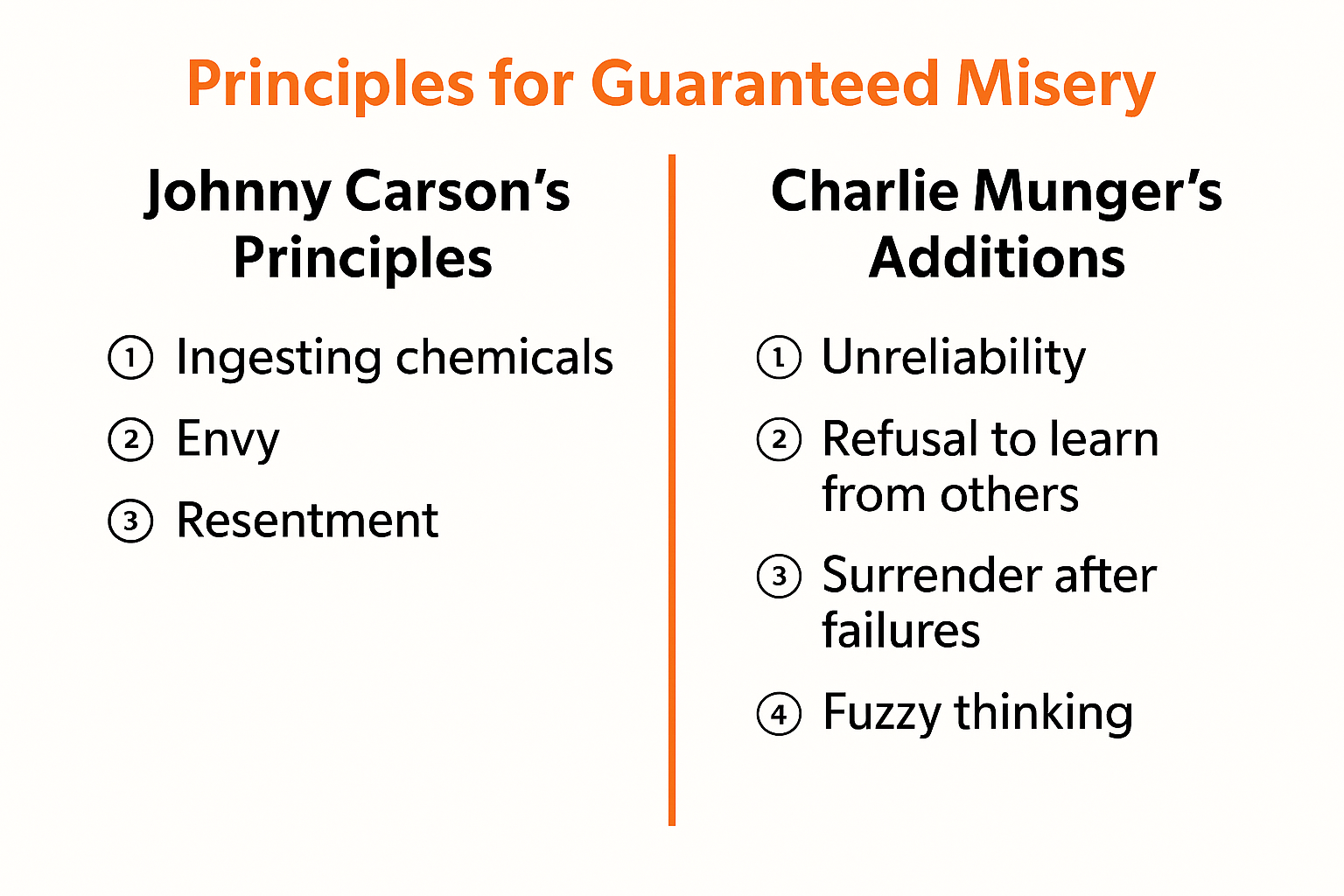
In the Harvard speech Munger said he expanded on the earlier graduation talk of Johnny Carson about guaranteed misery, because it was the only graduation speech he listened to and wished it was longer. Johnny’s three guaranteed prescriptions to unhappiness were:
- Ingesting chemicals (alcohol, drugs or other chemical dependencies)
- Envy (resenting others for what they have)
- Resentment (holding grudges and focusing on perceived injustices)
Munger added four more prescriptions to make life miserable: - Be unreliable (breaking promises or failing to follow through)
- Refuse to learn from others (closed mindedness)
- Surrender after failures (giving up after setbacks instead of persisting)
- Fuzzy Thinking (avoiding clarity, logic and reasoning)
The shared philosophy is that both men used inversion; showing what not to do. This aligned with the inversion principle of Munger, stating that a wonderful life can be created by avoiding the prescriptions for misery instead of pursuing success.
He ended his speech with the following words: “Gentlemen, may each of you rise high by spending each day of a long life aiming low.” (Quatr, 2025)
Carl Gustav Jacob Jacobi
The phrase was introduced by Carl Gustav Jacob Jacobi, a German mathematician who invented tools to handle complex equations and explain patterns in numbers.
Carl Gustav told his students the following:
One should ‘Invert, always invert’ (German original: “man muss immer umkehren”) (Wikipedia, 2025)
Based on his belief that inverting known results can lead to new research topics.
Diversified thinking
Munger emphasized the importance of using mental models (from math, psychology, biology, economics) to approach decisions. Inversion is one of those models, but it works best when combined with others.
Inversion is an opening to diversified thinking. Since it combines “What to avoid” with “What to consider from different disciplines”, together this can better equip you to avoid failure. In the next paragraph we will look at examples how to apply inversion.
How can I use Invert always invert?
The best way to understand Charlie Munger’s principle is through real-world examples. Below some illustrative examples of how you can apply inversion in your life.
Examples
- Productivity:
- Question: How do I stay productive?
- Inversion: What kills productivity?
- This will help you spot distractions and eliminate blockers.
- Investing:
- Question: How do you make money in the stock market?
- Inversion: How do investors lose money?
- The avoiding of concentration, risky businesses and chasing success.
- Philosophy:
- Question: How do you prepare for life’s challenges?
- Inversion: Stoics like Seneca practiced premeditatio malorum — imagining hardships and setbacks.
- By rehearsing failure, they built resilience and reduced fear.
Further Reading

- Poor Charlies Almanack (as an Amazon Associate I earn from qualifying purchases)
References
Wikipedia, 2025, Carl Gustav Jacob Jacobi, 22th of November 2025, Wikipedia Carl Gustav Jacob Jacobi – Wikipedia
Quatr, 2025, Speech: How to Guarantee a life of Misery, Quatr, Munger 1986 Speech: How to Guarantee a Lifeof Misery